Every healthcare practice runs on two things: patient care and getting paid for it. The second part, often called revenue cycle management (RCM), is where most of the financial stress in a practice comes from. If you’ve ever wondered why payments feel unpredictable even when patient volume is steady, the answer usually isn’t the care you’re providing. It’s the revenue cycle behind it.
This guide breaks down what revenue cycle management really involves, where practices typically lose money in the process, and how the right revenue cycle management services can turn an unpredictable billing process into a steady, dependable one.
What Is the Revenue of Cycle Management?
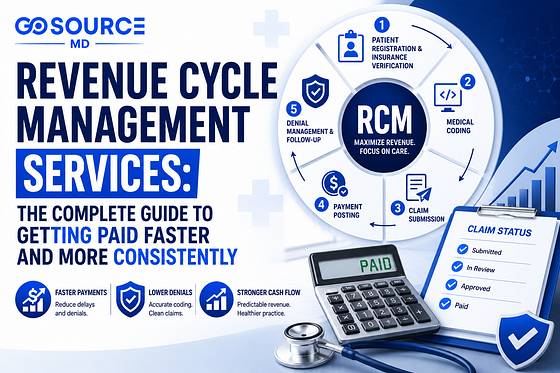
Revenue cycle management refers to the entire financial process a practice goes through to get paid for patient care starting from the moment a patient schedules an appointment, all the way through insurance verification, coding, claim submission, payment posting, and any necessary follow-up on unpaid or denied claims.
It’s easy to think of billing as a single step, but in reality, RCM is a chain of connected stages. A weakness at any point in that chain, even something as small as an unverified insurance detail, can delay or reduce the payment a practice eventually receives.
The Core Stages of Revenue Cycle Management
1. Patient Registration and Insurance Verification
This is where the revenue cycle actually begins. Incorrect patient information or unverified insurance coverage at this stage almost guarantees problems later. Claims get denied simply because the details on file don’t match what the payer has.
2. Medical Coding
Every service provided needs to be translated into accurate procedures and diagnosis codes. Even small coding errors, a mismatched code, an outdated one, or missing documentation are among the most common reasons claims bounce back.
3. Claim Submission
Once coded, claims need to be submitted cleanly and on time. Late or improperly formatted submissions are a frequent, avoidable cause of delayed reimbursement.
4. Payment Posting
When payments come in, they need to be posted accurately and promptly. Delayed or incorrect posting makes it harder to track what’s been collected versus what’s still outstanding.
5. Denial Management and Follow-Up
This is often the weakest link in most in-house billing setups. Denied claims are usually fixable, but only if someone follows up quickly. Left unattended, they quietly become a permanent revenue loss.
Effective revenue cycle management services treat all five stages as one connected system rather than five separate, disconnected tasks, which is exactly where most practices run into trouble.
Why Revenue Cycle Management Matters More Than Basic Billing
Basic billing focuses on “submit claim, wait for payment.” Revenue cycle management goes further; it examines the entire financial journey and identifies exactly where money is lost, delayed, or mismanaged along the way.
Practices that only focus on billing in isolation tend to see recurring problems: rising denial rates, longer days in accounts receivable, and cash flow that swings unpredictably from month to month. Practices that manage the full revenue cycle tend to see the opposite: fewer denials, faster turnaround, and financial predictability that makes it easier to plan staffing, equipment purchases, and growth.
Common Revenue Cycle Management Challenges
- High denial rates caused by coding errors, missing documentation, or eligibility issues
- Slow reimbursement timelines due to inconsistent claim submission
- Inconsistent payment posting, making it hard to know what’s actually been collected
- Staff stretched too thin to manage the full cycle carefully
- Lack of visibility into where revenue is getting stuck in the process
None of these issues are usually caused by one big mistake. They build up gradually, which is exactly why they often go unnoticed until a practice takes a closer look at its full financial picture.
How Professional RCM Services Solve These Problems
Dedicated revenue cycle management services address these gaps by managing the entire process end-to-end, rather than treating billing as an isolated administrative task. This typically includes:
- Verifying insurance and patient details before claims are ever submitted
- Applying accurate, up-to-date coding aligned with payer requirements
- Submitting clean claims the first time, reducing avoidable denials
- Tracking every claim through to payment, with immediate follow-up on anything denied or delayed
- Providing clear reporting so practices can see exactly where their revenue stands at any point
At Go Source MD, this is the foundation of how revenue cycle management services are delivered. Rather than handling billing as a disconnected task, the full cycle from patient intake to final payment is tracked closely, so problems are caught early instead of surfacing as lost revenue months down the line.
The Financial Impact of Better RCM
Practices that adopt structured revenue cycle management typically see measurable improvements: lower denial rates, shorter reimbursement timelines, and more predictable monthly revenue. Just as importantly, administrative staff spend less time chasing payments and more time supporting patients directly, which matters for both morale and patient experience.
Is It Time to Rethink Your Revenue Cycle?
If your practice deals with frequent denials, unpredictable cash flow, or a billing team stretched too thin to keep up, it’s usually not a sign that your team isn’t working hard enough; it’s a sign the revenue cycle itself needs a more structured approach.
Final Thoughts
Revenue cycle management isn’t just a back-office function; it’s the financial backbone of a healthy practice. Getting it right means fewer denials, faster payments, and far less time spent wondering where your revenue is.
Go Source MD’s revenue cycle management services are built to manage that entire process from patient intake to final payment, so healthcare providers get paid faster, more accurately, and more predictably.
Ready to streamline your revenue cycle? Talk to the RCM experts at GoSource MD and see where your practice could be gaining back revenue.